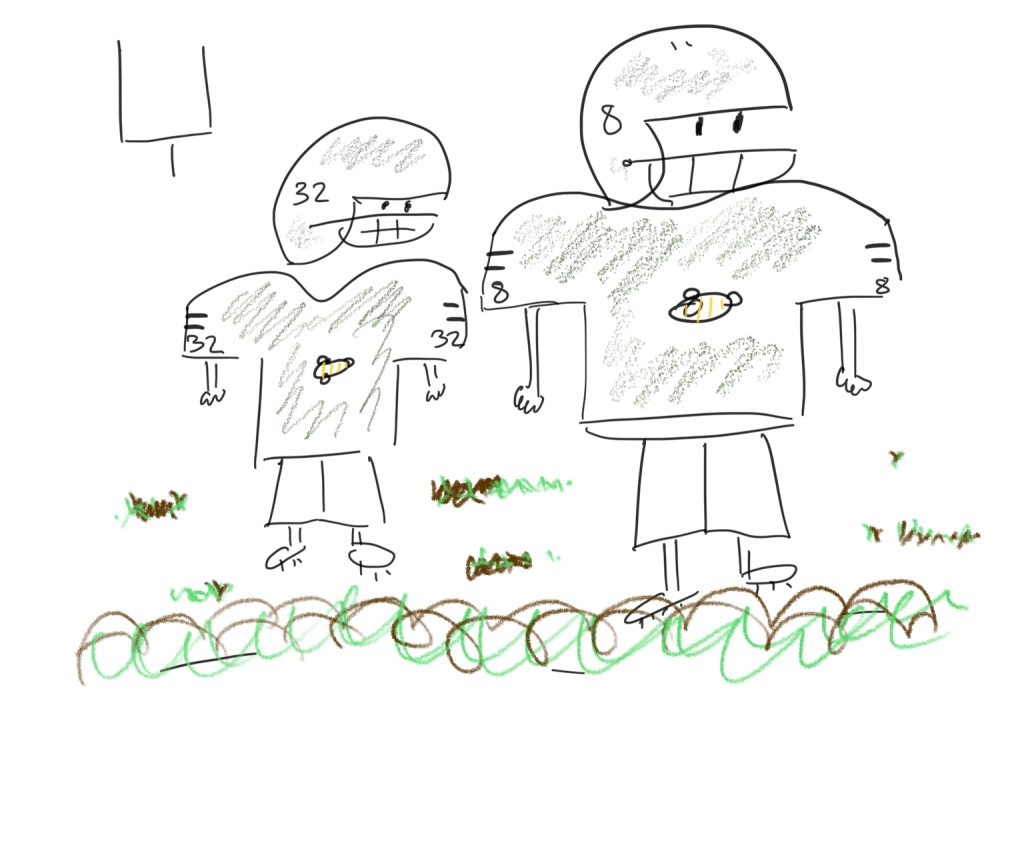
There’s few experiences from my elementary school days that I would willingly return to- body, mind, and spirit- but if I could, I would teleport back to youth football practice, to my illustrious career on the Green Hornets, where, during one exceptional season I played both fullback, cornerback, linebacker, running back, and lineman — each with Heisman-like form and prowess.
In particular I would relive one drill from practice, where three of us bobbleheads in pads would jump and tumble over one another; one hitting the ground and rolling aside, then the next jumping over him and rolling; each of us going back and forth in a wild skirmish of chicken legs and dust, with coaches and teammates behind us, gloating and egging us on.
It was pure circus act; a drill better suited to green piglets than green hornets. Even so, I would happily return to it, not least for the thrill, but also because it remains one of my earliest and most vivid memories of practice– of doing something hard that makes you better.
What are you practicing?
That question is the gist of this post. It’s a question I’m posing to myself lately, and one that builds upon a topic I opened earlier: namely, why should anyone take on a tall, creative project: writing a book, say, or rebuilding a car engine, or starting their own business? Or if they’re especially bold and wild-eyed, coaching a youth football team. Let’s stretch the word creative.
My running assumption is that there are plenty of people who have a desire to do something like this, but for one reason or another never get around to it. They defer. Or they get cold feet. The reasons I’ve been exploring are meant to help warm them up again. They’re meant to help warm me up again too.
In my first post I argued that a big project can help build confidence. In this post I want to make a case for practice. Specifically I want to riff on the old piece of wisdom that says practice makes perfect. True or not, what I’ll submit here is that practice makes purpose.
To start, one of my favorite passages on the subject of practice is taken from the Nobel winner, John Steinbeck. When Steinbeck was working on his monumental piece of fiction, East of Eden, he kept a journal that documented his daily progress. The journal took the form of letters addressed to his longtime editor and friend, Pascal Convici. In it he confided his thoughts about the story, his doubts and daydreams, his reluctance beginning work, and often his musings on writing in general. It was a way, as he put it, of warming up his mental arm for a good days pitching.
Somewhere along those pages he says that all his previous work was practice for this later story. It’s a bold statement, considering that previous canon included such gems as The Grapes of Wrath, Of Mice and Men, and The Pearl. But Steinbeck wasn’t being a provocateur. Nor was he being modest about his achievements. Rather, he was stating a truth as plain as day: one never outgrows practice.
However cozy this concept sounds at first take, I’ve noticed it falls out of vogue the further one slides out of the lockstep calendar of school years and extracurriculars, and into the buttoned-up workaday world where everything soups together. The idea, I mean, of practice as a purposeful pursuit; a foundational activity that one returns to, develops mastery in, and even earns pleasure from long after they’ve hit their goal(s).
That’s not to say that practice, or notions like it don’t exist in the quick-step corporate world. Indeed, we talk about upskilling and building competencies, and employing best practices, and developing deep expertise for this and that. But sometimes these terms give me the heebie jeebies. It’s not because they’re jargon, though. I have a stomach for jargon. It has more to do with my being unable to detach them from their contexts, from the sedentary world of the screen, with its pings and check ins and kpi’s. In contexts like these, what goes for practice is less a long term habit than a short term competitive advantage.
Granted, this is a personal bias, and it stems from an imaginative mismatch in my head. Whatever ‘practice’ conjures for you, for me it still calls up the itch of grass and the smell of shinguards; the shrill whistle, orange cones on the end line, wind sprints, penny bags, and anyone of the hundred athletic rituals I participated in when I was younger. To this day practice retains the kinetic, sportsmanlike meaning I formed as I grew up. But lest my opening story mislead you into thinking I was some kind of practice junkie, or eager beaver, I wasn’t. I resisted practice then, and I do now. Practice was hard. Practice was painful. Practice was early.
Overall I approached practice the way, Alan Jacobs observes, many modern readers approach reading; that is, we plow through books not to read, but to have read. It’s a retroactive accomplishment; something we treat like a necessary evil in order to check the box. We want to quickly digest knowledge and get on to the next thing. So with practice I became so bent on getting through it that I consistently overvalued the performance part and undervalued the pleasure and enjoyment that came from simply playing and improving.
For example, in high school I ran track and field during the winter season. As an off-season runner, track was at best a way of staying fit and at worst a form of organized torture. Some practices I played hooky. Others I showed up hoping we got ‘Burger loop’. Burger loop was the shortest and easiest of all the practice runs the coach would assign- literally a loop from the track to a local burger joint and back. It was considered an easy-off day, usually right before or after a meet.
Suffice to say I wanted every practice to be Burger loop, and most of the team did too. If we had our way we would have skipped stretching, run less, and magically showed up on race day and dazzled the coach with a PR, then spent the rest of the week putting practice on blast again. Thankfully we had coaches. But looking back I lament my old attitude. The groaning and the bitching, sure. But more significant was the poisonous view I took of practice, which is a long time detoxing.
It takes time, and in my case, plenty of mishaps, to switch one’s outlook from ‘what will I get out of this?’ to ‘what will this get out of me?’ The former is a more conventional response to life’s challenges, but the latter I’m finding is more fulfilling.
After the season ended, and high school finished, and college passed, and jobs ran their course, I realized something important about all this. I realized that the meaning of Burger loop—the spirit of it you might say, never goes away, but dogs you and keeps dogging you at every pass. Burger loop, plainly speaking, is the perpetual temptation to put in the least effort for the maximum results.
The other important thing I realized is that once practice ends it need not begin again. The whistle stops. No one cares if you play hooky. To some that sounds like paradise. It’s easy to assume, anyway, that once we leave behind the tedium of imposed practice behind, we’ll be free to spend our time doing things we really want. But what I’ve found is that the opposite is true. As time goes on, we tend to fall out of practicing something and into performing anything; usually the things in our immediate sandbox: responsibilities, tasks, assignments, roles, which we perform and gradually bundle into that stark word, ‘experience’.
The athletic analogy to all this is that instead of drills we take the treadmill. Instead of sprinting the 400m, we put on sweats, hug the outside lane, and jog easy laps towards some indefinite finish line in some indefinite race.
At this point, if you’ve kept your nose to my argument, you might detect a whiff of contradiction in the reasoning. In one instance I’ve suggested that practice should be a long pursuit, a marathon of sorts. In another I’ve suggested that practice can be compared to sprinting the 400m. But in fact, I believe both are true. The point of emphasis is not the duration of the activity or it’s intensity, but it’s direction, or purpose.
Approaching a creative project as practice helps build purpose. It encourages a mindset shift from incidental doing to intentional doing. More over it forces us to specify how we’re doing it, and how those skills are integrated. In other words practice makes us reconsider the form of our work, and not solely the content. According to Cal Newport, this is a rare approach these days.
When we sever practice from performance, we risk blurring the distinction between the two. Instead of purposeful doing, we get ambiguous activity; mindless motion. Practice, therefore, helps us see our work as occurring in meaningful cycles and not merely part of a never ending stream of tasks and obligations.
How do we get back to practice? The first step may be as simple as asking the question: What are you practicing? From there the answer may be staring you in the face. Or you may have to wind the clocks. You may have to lace your cleats and find that drill that gets you tumbling and tossing in the dust of life again.
 show & tell