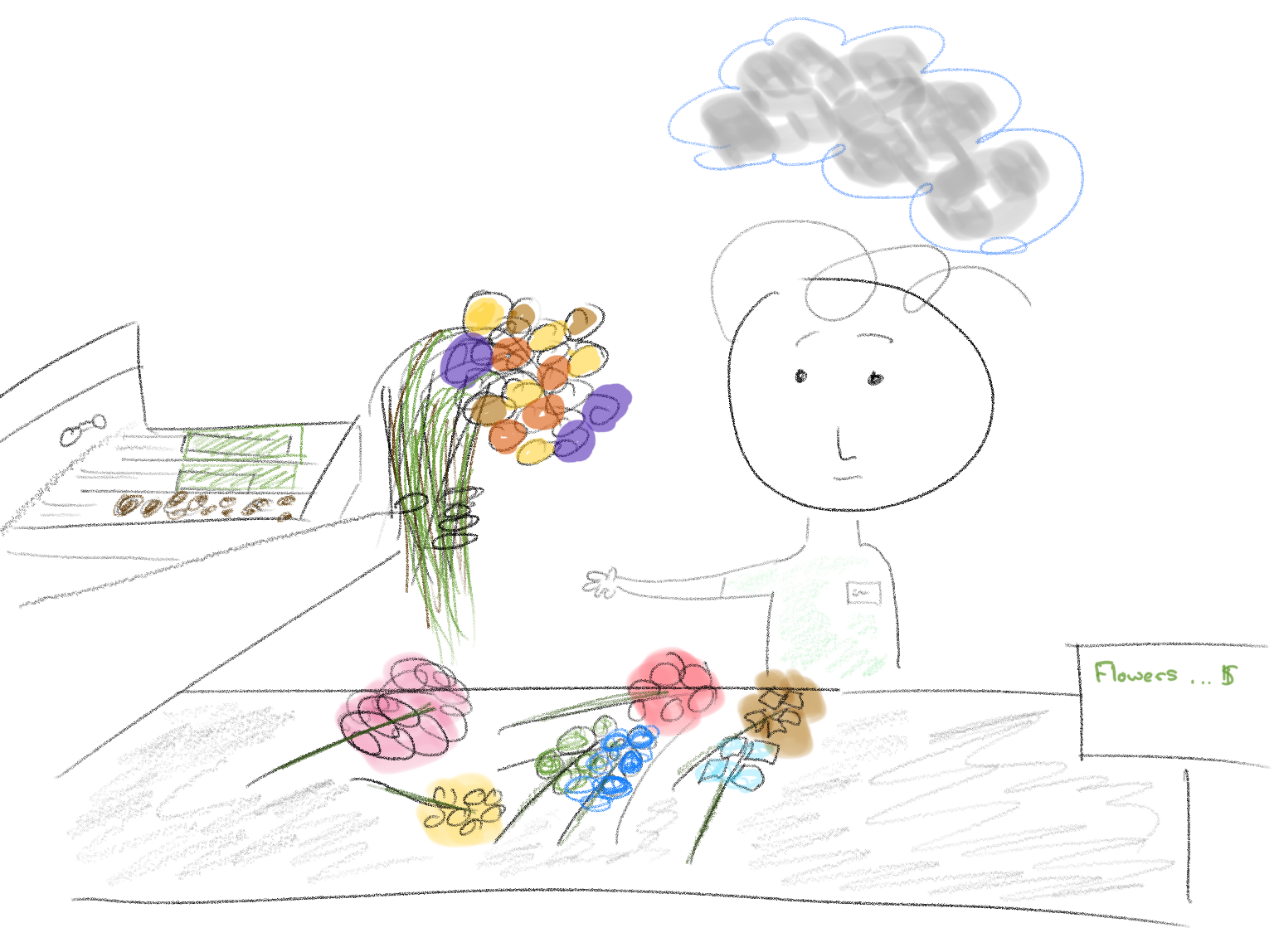
The other day I had an experience which reminded me how contagious our attitudes are and how deadly despair is. I was standing in line at the dollar store waiting to check out. The man in front of me was next in line. He was plucking a huge bouquet of bright, colorful, fake flowers from one of the rotating stands at the end of the register. I was quickly engrossed by this random act of delight and I couldn’t help but wonder who or what these flowers were for. But as soon as the man made it to the register all the flowers seemed to wilt at once.
The employee at the register looked at the bouquet, frowned, and said with a heavy sigh,
‘How many do you have?’
‘I don’t know.’ the man replied, looking over his collection.
The employee rolled his eyes.
‘You mean I have to count all these?’
The man with the bouquet apologized and offered to count them, but the employee tossed his head despondently, dropped his head and moaned, ‘Nevermind’, then started scanning them one by one, as though a cloud of permanent discontent had settled over his head.
The line of customers wove through the store, and looking back I saw that we were all hypnotized by this unfortunate exchange. We all shuddered the same shudder of embarrassment. Standing behind the man, I felt awkward and agitated and I wanted to get out of the store as soon as possible. It was the kind of encounter that made one want to avoid the company of humans altogether and go pet a dog. In any case, the line moved, life proceeded, and we got on with the day. The peculiar thing about this event was that later, even days later I found myself ruminating about that moment. However brief it was, however commonplace and glancing and perhaps even excusable it was, it still hung over me like the same dark cloud that hung over the guy at the register – and the more it lingered there eating my peace, the more it begged like some anomalous evil to be given a name. What was it that bothered me?
I finally did give it a name, and the name I gave it was despair. We have all known despair in one form or another: that state of discontent, dissatisfaction, or disenchantment, when the joy drains out of life and we find ourselves going through the motions. But the pernicious kind of despair I saw at the store was different. I felt it before I had a word for it; what especially gave it away was the contagious feeling of sadness that seemed to drift from the register through the store like a wreath of smoke. It was the sadness exhibited by the employee; the sadness of doing one’s job, of complying with the work.
In a way it was certainly similar to what is classically known as acedia, or the ‘noonday devil’; the sluggishness that hits us in the afternoon, sapping our energy and inhibiting us from starting our work. Yet the despair at the register was distinct even from that. It was also distinct from what we think of as lethargy, depression, or a weak work ethic, though it shares obvious similarities with each. The point of diversion between these and the symptom I saw was that the employee in question, the man beleaguered by the bountiful bouquet, was strangely and straightforwardly good at his job. He was rather quick and workmanlike and proficient. He was not, as you might otherwise imagine, a dullard or a slowpoke. He was not derailed by the flowers, or intimidated by the size and tediousness it required, or worried about the people waiting behind. It was rather that the bouquet drained him. He looked, odd to say, grieved by it. Saddened by it. Threatened by it. It seemed to deplete his spirit, but not his productivity.
During the tenure of my working years, I’ve come to see that this kind of quiet, slow dripping despair is the prevailing despair of the American workplace. It is a much more common, and might I add much more dangerous despair than the paralytic, bleeding out on the ground affair we sometimes think of when we hear the word. That kind of high pitched despair is justified and proper in moments of acute and anguish. Like a gust of strong wind it comes and the it goes. But this kind of covert, slow winding despair is most dangerous because it is a relatively high functioning parasite, enabling its victims to maintain highly productive profiles on the outside while being silently shriveled to death by a lack of meaning on the inside.
In so small a space I don’t dare offer a comprehensive review of this broad and far reaching subject; I’m content here to touch on what I’ve seen at street level. Suffice to say the despair I’ve spotted in offices is not compartmentalized or confined to worklife. Rather, like a virulent weed it spreads it’s roots into all departments of life. I have many peers who, in addition to the sadness I’ve observed, experience despair as a gut-level lostness, a quiet, nagging unhappiness which is independent of their material welfare or social standing. This feeling is especially disturbing because these peers are, by all appearances and by their own appraisal, doing well for themselves. They are educated, employed, socially mobile. They are fed, sheltered, clothed. They have hobbies; they’re having sex; they laugh at tv shows. And yet, they are inexplicably bored with life; putting in long hours of work and yet constantly self critical that they’re not doing enough. This isn’t the same as being depressive. To use an image, it’s not like the duck who is calm above water and paddling like hell below; it’s more like the duck flipped over – the feet are paddling in the air, the head is under. There’s something upside down about it.
One of the common misconceptions I’ve discovered is that we tend to conflate despair with depression. Moreover we often assume that both despair and depression are the result of a shrunken ego. What I’ve seen however is that despair is really the result of a swollen ego. Depression may be like an underfilled balloon. Despair is like an overfilled balloon. The two are vastly different, even categorically different. Depression is a crisis of energy. Despair is a crisis of pride. Depression cannot put its hand to the plow. Despair can’t take its hand off the plow.
If I have found one reliable method for hunting despair it’s this: sniff complaining. Complaints are the termites of speech and they are often a tell tale sign that despair is lurking nearby. This is what I noticed about the employee at the register – the swift succession of complaints – and what I’ve noticed in places where’ve I’ve worked or served clients: wherever complaining was most prevalent, that is, wherever groups of two and threes gathered informally and gabbed about the stupidity of the boss or the laziness of their coworker or the futility of the work or the crappiness of the client, there was invariably an atmosphere of mistrust that hung in the air like a foul exhaust. It manifested in bouts of cynicism, egotism, envy, rivalries, passive aggressions and someone suddenly flying off the handle. All the fruits of despair.
The reason we complain is to maintain an illusion of control over a given situation that threatens us with disorder. It’s a coping mechanism for challenges and uncertainty. By labeling something quickly, especially something we do not like, we create the illusion that we are cutting it down to size, but in reality we are doing the very opposite. When we complain we magnify the object of our concern. We give it precedence in our attention. Instead of stripping it of its menacing potential we empower it, feeding it incrementally until it assumes a size and threat greater and more formidable than what it started as. Gradually we become the victims of our language.
It’s true that not all complaining flowers overnight into an intractable obstacle, but all complaining depletes optimism. Over time it fertilizes negativity and pessimism, eating away at the integrity of our attitudes. Attitudes spread, and that’s why complaining does not breed in a vacuum, but thrives in a culture. The counterweight to a culture of despair is finally a culture of hope, one that steadily revises and purifies its language from the ground up. In and of itself this change is no silver bullet; it does not immunize one from competition and difficult decisions and the ongoing risks of running a business. But it does alter the outlook. A firm committed to such change begins to speak of its inevitable setbacks and sloughs and miscommunications not merely as undesired evils but as prime opportunities to grow and excel. To put it bluntly: it watches its strategy, but it also watches its tongue. This is not just good psychology, it’s good business.
Disarming despair means ending its inertia. It means cutting off its supply of deadly fuel. Overcoming despair is not a quick fix, but it can be quickly assessed. Start by listening. Put your ear to the ground and begin to notice the amount of complaints you and others speak on a given afternoon. Listen for it on your calls, in your meetings; make a tally on piece of scrap paper. Then, like a farmer who has found weeds among the wheat, begin to patiently uproot.
 show & tell