I’ve been thinking of a conversation I had a while back with one of my mentees, a guy who played baseball in college. I wanted to know if there was anyone on the team who, baseball skills aside, stood out, who all the other guys respected — a motivational outlier.
He said yes, there was someone who came to mind. Although he didn’t fit the usual leadership mold. He wasn’t a captain, and he wasn’t considered one of the stars. He was an underclassmen actually. But his teammates admired him for his work ethic.
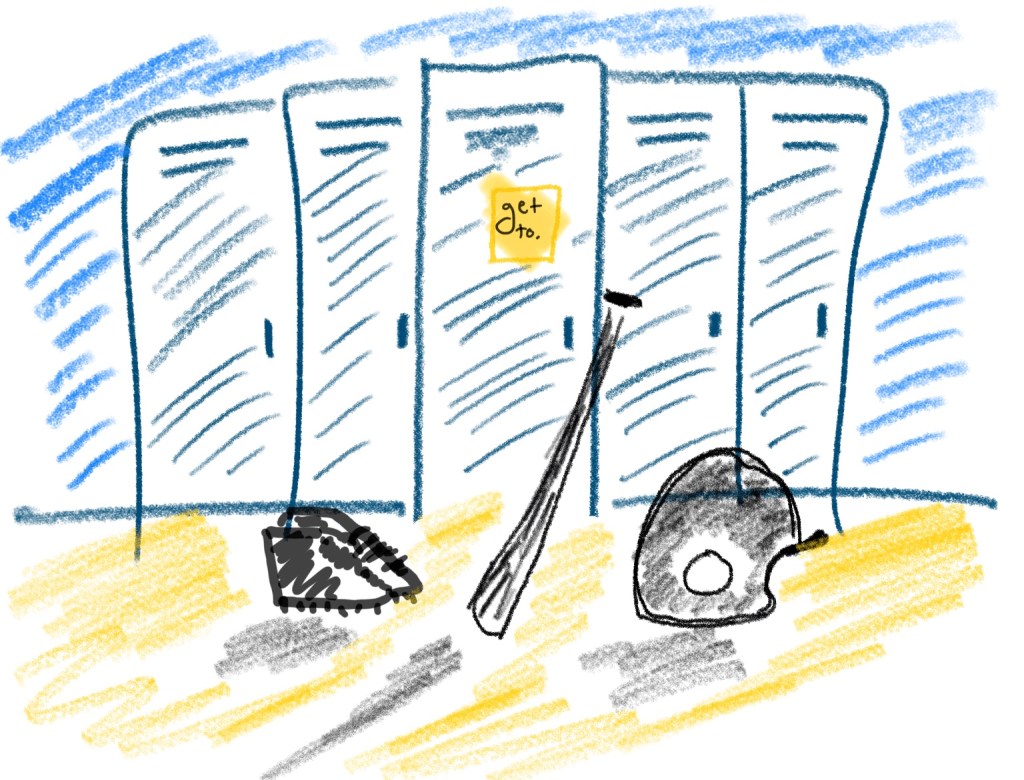
I assumed that meant this guy was a grinder: he worked hard, he worked long, he took it on the chin, he stayed after practice and ran drills. And maybe he did. But when I asked my friend to elaborate, he told me something much more insightful: he said his teammate kept a note on the outside of his locker that read: ‘Get to.’ When the rest of the guys slouched into the locker room bemoaning practice, he was silent. He was smiling.
Ever since I heard that story, I’ve remembered that phrase and pasted it to my own proverbial locker. It’s sticky. Only two simple words. But two words as fiery as a fastball. ‘Get to’ is powerful because it inverts another tired phrase that seems to dominate so much of our lives: ‘Have to’.
I don’t know when have to became so prevalent. Or when life began to feel so overwrought with tedious obligations. Everywhere I hear it. I have to do this. I have to do that. I have to work. I have to finish this paper. I have to make dinner. I have to finish this email.
However innocent it sounds, I believe this common phrase reflects a underlying attitude toward life that is pernicious in the long run. The phrase has a cadence like a hammer blow, flattening any activity into a very blunt, very matter of fact Thing To Do. To be sure, I’m not denouncing duties. Nor am I denying the importance of stating obligations and keeping them. Far from it. No meaningful life is lived without meaningful obligations. Without showing up, and keeping your word, and taking out the trash.
The point is that life is not only obligations. Many of the activities we undertake, or find ourselves mysteriously involved in, are not strictly things we must do. They have become that way. What once began as an exciting job, relationship, hobby, goal – over time grows weary, dull, familiar. Duty has grown over them like an ivy. Even so, this downward slope is not inevitable. We shape our experiences by our approach, that is, our attitude; by what we consistently think and say about it.
I suspect our language matters a great deal on this account.
A language of habitual duty may not warp us into pessimists and cynics overnight — but it may jade us subtly. It may tinge our outlook on the small matters; which, later on, become the big matters. Instead of seeing the glass half full, or even half empty, you see just the glass. Instead of racing down the road of adventure, you just roll down the road, and a bumpy one at that.
Slowly, perhaps imperceptibly, we become more Marthas than Marys.
To put it another way, the peril of overlabeling obligations is that we impair our ability to see the same activities and experiences as opportunities. In overemphasizing the task of life, we underemphasize the givenness of life.
The goal is not to halt the obligatory impulse — but to slow it. The aim is not to relinquish responsibility, but to continually see more responsibilities as means of growth, and sources of wonder.
We’ve all been schooled, one way or another, on how to build a better attitude. But the first step, and perhaps the most challenging, is realizing you have one. Only then can you give it a nudge. If life feels like a long, never finished chore, flip the script. Get to. Put it on your locker. It might make the day feel more like a ball game.
 show & tell